Showing posts with label My Country. Show all posts

Tuesday, April 1, 2014

Takeo, Cambodia


Takeo province is often referred to as the cradle of Cambodian civilisation Takeo province has several important pre-Angkorian sites built between the 5th and the 8th century. The provincial capital, Takeo town is an easygoing place that possesses a fair amount of natural and manmade beauty. The natural beauty is in the Scenic River and lake area that faces a pleasant town parkway. The low-lying area seems to include much of the surrounding province area, which is probably why a kingdom that once had its heart here was referred to as Water Chenla. There seems to be water everywhere in the surrounding countryside during the rainy season.

The man-made beauty mostly comes from a series of canals and waterways that were cut through the surrounding countryside, many a very long time ago, connecting towns, villages, rivers and Vietnam. Nearby Angkor Borei town (connected by water to Takeo town) may have been the heart of the Funan Empire, which is called the Cradle of Khmer Civilization by Cambodians. Much older than Angkor, the Funan empire had its heyday between the 1st and 6th centuries and stretched across a vast area, from South Vietnam through Thailand, down through Malaysia and into Indonesia. Bold, silver and silks were traded in abundance in the kingdom, or, as some say, the series of fiefdoms.

Although Cambodians claim Funan was created by Khmers, neighbouring Vietnam argues that they were the people of origin. Archaeologists from the University of Hawaii of the USA have made research trips to Angkor Borei in an attempt to piece together the history and story, and story, as well as relics, of the Funan period. In an odd recent twist, Reuters News Service reported in early November 1999 that locals saw the research team digging up ancient relics and figured the stuff must be valuable, so they started digging and looting objects from the area. Fortunately, the Cambodian government seems to be moving in on the problem quickly to try to save what they can of this important piece of Khmer heritage.

That was not the first time the locals have created problems in the piecing together of ancient history. Much of what did remain in the form of ancient ruins in Angkor Borei was destroyed not too long ago in the modern past. The officials that runs the museum that's dedicated to the history of the Funan empire told me that much of what was still standing from this period (from parts of ancient walls to partial structures) was thought to be useless by locals and was bulldozed and razed to make way for more useful modern day structures! Talk about having a bad track record. Fortunately artifacts and history have been put together in the museum.

Takeo Province is full of other interesting sights as well and because of the short distance and good road from Phnom Penh, all are great day trips. Some sights can be combined in a day trip. If you have a bit more time, spend an evening in Takeo town and take in all the sights. There is a pleasant little place to stay overlooking the river and lake area.

Tourist Attractions in Takeo


- Angkor Borie
- Chruos Phaork
- Chup Pol Temple
- Museum
- Neang Khmao Temple
- Phnom Ba Yong
- Phnom Chiso (Chiso Mountain)
- Phnom Da
- Phnom Ta Mao (Zoo)
- Phnom Ta Moa
- Ta Prohm Temple
- Tonle Bati
- Wat Phnom Khliang
- Yeay Pov Temple            

Svay Rieng, Cambodia


Svay (pronounced Swai) Rieng is on of the smallest and sleepiest Cambodian provinces that just happen to have one of the country's busiest highways running straight through - National Highway No 1, which links Phnom Penh and Ho Chi Minh City in Vietnam just after you cross the Mekong River by way of the Neak Loeung Ferry. It is also one of the poorest provinces of Cambodia due to the poor quality of the land. Most of the provincial population eke out a subsistence living based on farming and fishing.

Svay Rieng is the provincial capital, a sleepy town just 43 km from the Bavet border crossing. This is a fairly prosperous place as a result of the border trade traffic, business people and travellers passing trough. The town is a very friendly place and makes for a pleasant overnight stop whether coming from or going to Vietnam.

Svay Rieng town is situated near the Waiko River and its vast, scenic marshlands, the result of a wide stretch of the river drying up significantly over the years. It's a pleasant setting and one that can be enjoyed at several different spots along the river and marsh. A bridge over the Waiko, not far from the main part of town, bears a plaque that states prime minister Hun Sen donated the bridge.

During the long Vietnam War, American forces believed that this was the place, where Vietnamese communists had their intelligence headquarter. For sure there were undoubtedly a lot of Vietnamese communists hiding especially in the South of Cambodia during much of the war, but there wasn't a strategic centre like the Pentagon here. In 1969 the Americans began unauthorised bombing in this area and in 1970 joined with South Vietnamese forces for a big ground assault.

Stung Treng, Cambodia


Stung Treng is a northern province of Cambodia. It was formerly called Xieng Teng and was once a part of the vast Khmer Empire, then the Lao kingdom of Lan Xang and later the Lao kingdom of Champassack. During the period of French Indochina it was again ceded to Cambodia.

The provincial capital is also named Stung Treng and is an important trade hub with a few hints of Lao influence scattered about, owing to the fact that the Lao border is about 50 km away. It's a friendly, quiet country town situated on the confluence of the San River and the Mekong River. It actually sits on the banks of the San River, with the mighty Mekong coming into the picture on the northeastern outskirts of he town.

The San River goes by three names, depending on which of the locals you speak to. Some call it the Kong River because the San and Kong Rivers merge together about 10 km northeast of Stung Treng town, confusing people about which name the river should bear. Others call it the Sekong River, which is the combined name of these two rivers. Whatever name the fiver beside the town goes by, it's another one of Cambodia's beautiful picture-postcard river towns. It's a nice place to kick back and chill out if you are on a circuit tour of the Northeast River Scene, from here to Laos.

The San River is fronted in Stung Treng by a nice stretch of paved road. It's the centre of socializing (as in most Cambodian river towns) in the late afternoon and early evening hours as the locals ride up and down the stretch enjoying the view and each other. Drink and dessert stands spring up earlier to serve the daily merrymaking crowd. It's a nice spot for a walk or jog any time of the day as the river road turns into a pleasant rural road that leads to the airport 4 km north of town.

The river port area just in front of the small city park is fairly busy, handling trade between Cambodia and Laos. The ferry across the San River to where National Highway No 7 continues north to the Laos border is also at this pier. The fare is 300 riel per head. We went for a ride on this stretch (2,000 riel for taking a big bike on the ferry), but there is not much to see along the way besides light jungle and some remnants next to the road that was a target of carpet bombing during the Vietnam War years (the road was recently overhauled and is now one of the best in the country). The road works its way eastward so it does not afford views of the Mekong River as one would hope. The few residents we saw along the way were truly amazed to see the likes of us, who would want to be there.

Tourist Attractions in Stung Treng


- Fresh Water Dolphin
- Hang Kho Ba Pagoda
- Kantuy Ko
- Koh Ksach Resort
- Mekong Discovery Trail
- Mekong River Trip to Laos
- Ou Pong Moan Resort
- Phnom Preah Theat
- Preah Ko Temple
- Pream Buorn Lveng Temple
- Thala Barivat Resort
- Wat Phnom, Stung Treng
- Wildlife            

Sihanouk ville, Cambodia


Sihanoukville province is a small southern province of Cambodia. The capital sits on a peninsula with beaches and tropical islands around. Sihanoukville (also known as Kampong Som or Kampong Saom) was founded in 1964 to be the only deep-water port in whole Cambodia. It is gradually being redeveloped as a tourist attraction, but despite the promise of massive Malaysian investment - a casino is planned for Naga Island - tourist numbers are still fairly low. Also its nice with sand beaches and several paradise islands have made it popular as a tourist destination.

In honour to the king, who fought for the independency of Cambodia the provincial capital was called Sihanoukville. Located in the southwest corner of Cambodia, 232km from Phnom Penh, Sihanoukville can be reached via National Highway No 4. White-sand beaches that include Ohchheuteal, Sokha, Pram Pi Chan, and Deum Chrey beautify this coastal city. These beaches are known for their quiet, cosy atmosphere and the large stretches of white sand and clear waters and these make them popular spots for families on vacation. These seaside paradises with the refreshing coolness of the fresh water streams can be enjoyed all year round.

Business opportunities in Sihanoukville are varied from financial activities to tourist and travel-related industries in conjunction with the government's objective of making Sihanoukville a major tourist destination besides its status as an International Offshore Financial Centre. The government welcomes both foreign as well as local investors to participate on a joint-venture basis.

This famous see side resort is formed by wide and huge streets and quite new big concrete buildings, which lost any impression of the former architectonical colonial style. As the town is not a small place due to it's wide spread urban areas, the best way to get around is to hire a motorbike. Beside the nice beaches and some very nice vantage points there isn't that much to see in the town itself.

To catch a nice view on the city you best climb the small hill to Wat Leu. Wat Krom is another place of interest as this is a recently build pagoda, because the older one was destroyed by the Khmer Rouge and it houses a sanctuary called Yeah Mao, the guardian of the cost. Nearby to the town there are nice places for a detour such as the Ream National Park and the beautiful Kbal Chhay Waterfall.

Tourist Attractions in Sihanouk ville


- Deum Chhrey Beach

- Independence Beach

- Kbal Chhay Waterfall

- Koh Pors

- Koh Rong Island

- Ochheuteal Beach

- Otres Beach

- Phnom Leu

- Picnic Resort

- Prampi Chaon Beach

- Prek Treng Beach

- Ream Beach

- Sokha or Serendipity Beach

- Vistory Beach or Lomhe Kay

- Wat Krom

- Wat Leu               


Siem Reap, Cambodia


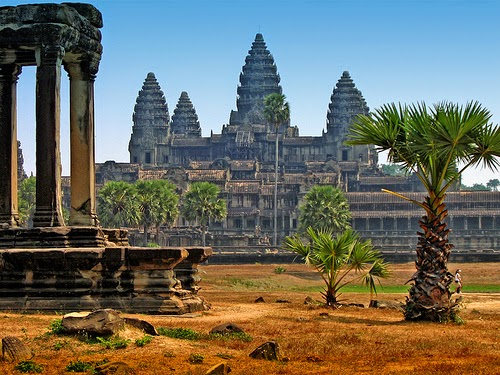
Siem Reap province is located in northwest Cambodia. It is the major tourist hub in Cambodia, as it is the closest city to the world famous temples of Angkor (the Angkor temple complex is north of the city). The provincial capital is also called Siem Reap and is located in the South of the province on the shores of the Tonle Sap Lake, the greatest sweet water reserve in whole Southeast Asia. The name of the city literally means Siamese defeated, referring to the victory of the Khmer Empire over the army of the Thai kingdom in the 17th century.

At the turn of the millennium Siem Reap was a Cambodian provincial town with few facilities, minor surfaced roads and little in the way of nightlife. Tourism industry catered largely to hardy backpackers willing to brave the tortuous road from the Thai border on the tailgate of a local pick-up truck. There were a couple of large hotels and a handful of budget guesthouses. Tuk-tuks and taxis were non-existent and the trusty motodup was the chosen means of touring the temples of Angkor.

The proximity of the Angkorian ruins turned Siem Reap into a boomtown in less than half a decade. Huge, expensive hotels have sprung up everywhere and budget hotels have mushroomed. Property values have soared to European levels and tourism has become a vast, lucrative industry. The Siem Reap of today is barely recognizable from the Siem Reap of the year 2000.

Though some of the town's previous ramshackle charm may have been lost the developments of the last few years have brought livelihoods, if not significant wealth, to a good number of its citizens. This has been at a cost to the underprivileged people living within and beyond the town's limits that now pay inflated prices at the central markets and continue to survive on poorly paid subsistence farming and fishing. If Cambodia is a country of contrasts Siem Reap is the embodiment of those contrasts. Despite the massive shift in its economic fortunes, Siem Reap remains a safe, friendly and pleasant town. There is an endless choice of places to stay or dine and a host of possible activities awaiting the visitor.

Tourist Attractions in Siem Reap


- Angkor Handicraft 1

- Angkor Handicraft 2

- Angkor National Museum

- Angkor Wat

- Angkor Zoo

- Bakong Temple

- Baksei Chamkrong   

- Banteay Kdei

- Banteay Sam Re

- Banteay Srey Temple

- Baphuon

- Beng Mealea

- Bird Sanctuary at Prek Toal

- Civil War Museum

- Crocodile Farm

- East Mebon

- Kbal Spean

- Khmer Classical Dancing

- Kompong Khleang

- Kompong Pluk

- Phnom Bakheng

-Phnom Krom Hilltop Temple 

- Phnom Kulen National Park

- Preah Khan Temple

- Prek Toal and Bird Santuary

- River & Park Area

- Srok Yeung or Our Ecotourism Site

- The Great Lake Tonle Sap & Floating Village

- Thmat Boey                        


Rattanakiri Cambodia


Ratanakiri is located in Cambodia's far northeast bordered by Laos to the north, Vietnam to the east, Mondulkiri to the south, and Stung Treng to the west. This rural rugged province is a 70% ethnic minority, which are known as "Chunchiet". Ratanakiri was as recently as 2002 seriously off the beaten track but has since been "discovered" step by step.

Still, while you won't get any bragging rights for coming here, it's well worth the effort to do so, and once you get away from it's capital Banlung you won't run into too many other tourists. So Ratanakiri is still a remote province in Northeastern Cambodia worth to visit. The word "Ratanakiri" itself is a derivative of two Cambodian words, which are combined to mean "place of gems and mountains." The word comes from the Sanskrit words Ratna (gem) and giri (mountain).

It's quite dusty capital, Banlung, is located in the central highlands of the province, approximately 365 miles (586 kilometres) from Phnom Penh and reminds one of a wild western city, even if it's the wild east. Its wide red laterite roads are bordered by new, recently build houses replacing the older ones. The centre of the town features a lively marked with all the needful things.

Lomphat is a small town in the southern plains, which was once the former capital of Ratanakiri. There are a few other small towns like Ta Veng and Voen Sai. The province is getting more and more popular for thousands of tourist every year. Especially for those, who seek a close contact to originality, hidden roots of ethnic groups and abundant wildlife. Therefore the Ecotourism abounds, due to lush wildlife and remote tribal villages. Most of the inhabitants of Ratanakiri are indigenous minorities.

Ethnic Cambodians make up only 10-20% of the country's total population. Remnants of an ancient volcano exist near to Banlung in the form of a crystal-clear lake that was formed after the active volcano went dormant. There are also a few ancient lava fields that testify to the fact that the area was quite lively at one time. Beautiful waterfalls, clear rivers winding through stretches of jungle, and rolling hills that meet mountains near the Vietnamese and Lao border provide a full agenda for nature lovers. Non-structured, low-impact, custom trips to outlying villages and natural areas can be organized (strictly by yourself or with help from a guesthouse).

There is a few foreigners living in Banlung you'll definitely meet while walking in the streets you can ask for actual tour offers, prices etc (change spontaneously). You will soon realize that this area hasn't seen a lot of tourists in the past. If you will visit the hill tribe people in the further areas outside of Banlung, don't be surprised if they look appalled at you. They just haven't seen many, if any, foreigners.

Yeak Laom Volcano Lake: This beautiful place is not far from town and is great for a swim, picnic, or hike around the crater rim of the old volcano. Due to the lake's tremendous depth of 48 meters, its water is exceptionally clean and crystal clear. The lake is almost perfectly round and measures around 750 meters in diameter. It has a small informative local museum thrown in to boot. In 1995 the governor of Ratanakiri officially set aside a 5,000-hectare (12,350-acre) protected area, of which the lake is a part, and in 1996 got help from the International Development and Research Centre of Canada and the United Nations Development Program to develop an effective resource management program.

This area represents Cambodia's finest attempt at preserving a site. Full-time rangers work to ensure the area is protected. They receive regular training and have put up signs throughout the area reminding people not too littler, wash clothes or toilet in the lake. That's amazing for Cambodia. The main swimming and picnic area features a nice wood deck that's great to use for a jump into the crystal clean water. Nearby, park rangers erected a couple of examples of hill tribe construction in the form of non politically correct bride and groom homes, where the man gets the elevated home (his status in the relationship) and the woman has the one nearer to the ground.

A few hundred meters down is the Cultural and Environmental Centre, which has information about area history and displays of local hill tribe tools and handiwork. They also sell some of the handicrafts made by the hill tribes: musical instruments, beaded belts, shirts, and hats. From the centre you can take a nature trail around the entire crater rim. King Sihanouk had a chalet built on the shores of the lake and used it during the 1960s. It was destroyed in the 1970 war between the Lon Nol government and Khmer Rouge guerrillas.

You can still see the remnants of this and also-indifferent spots around the lake-trenches that held gun emplacements during the fighting. The original inhabitants of the area are the Khmer Leu hill tribe people, who have always recognized the lake as a sacred place, home to the spirits of the land, water, and forest. Here those spirits interact with humans and, according to the local legend of Yeak Laom Lake, fabulous, spiritual aquatic beings reside here.

The surrounding forests of the area are also said to be the home of spirits and therefore can't be cut. This helps to explain why the hill tribe people took so strongly to the idea of protecting the area. It's very easy to get there - just go east from the Independence Monument circle 3 km to the Hill Tribe Monument circle (two indigenous figures) and go right for about 1,5 km to the entrance gate. The local hill tribe community connected to the lake get to collect an entrance fee, giving them a source of income and revenue for protecting their resource. It?s US$1 per person and a few hundred riels for a motorcycle.


Tourist Attractions in Rattanakiri


- Beung Yeak Loam

- Cha Ong Waterfall

- Eisey Patamak Mountain or Phnom Svay

- Ka Chanh Waterfall

- Ka Tieng Waterfall

- Lumphat Wildlife Sanctuary

- Norng Kabat Forest

- Ou'Chaloy

- Ou'Sean Lair Waterfall

- Ou'Sensranoh Waterfall

- Viel Rum Plong

- Virochey National Park, Tonle San River & Beyond

- Wat Rah-Tahn-Ah-Rahm(Reclining Buddha)