Wednesday, April 9, 2014

We want out of Ukraine: Donetsk protesters dig in at government building


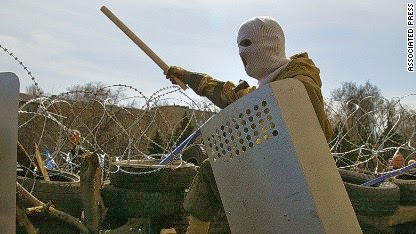
Masked men with metal rods and Molotov cocktails prowl the Russian flag-draped balcony, surveying the crowds below. Stacks of tires topped with ribbons of razor wire line a makeshift barricade around the main entrance.Two days after smashing their way in, hundreds of protesters have transformed this government building in the industrial city of Donetsk, eastern Ukraine, into the self-declared "People's Republic of Donetsk."

From the clumsily erected bulwarks to the lack of a leader or concrete plan, the scenes are similar to the pro-European rallies in Kiev's Maidan Square in recent months, with one major difference: Many of these protesters say they want to join Russia and have called for a referendum on secession from Ukraine to be held by May 11.

The protesters who let us into the building are eager to show they are here entirely peacefully, but it is clear they are prepared for a fight. Doors have been locked and stairwells blocked at the top of the building to prevent the Ukrainian military from storming in from above. They've smashed the pavement outside the building to use as stones. A makeshift hospital and temporary cafe have been constructed, and locals are keeping the men and women inside stocked up on food and medical supplies.

Some of the protesters inside the building are happy to see us; others seem ready to attack us with their bats at a moment's notice. Some are aggressively anti-American. One of the older men asks us why Americans are sticking their nose into Ukrainian affairs.One man tells us that he's from the Eastern Front, a new local group, and that help is on the way. He says there are 6,000 members of his group who stand ready to "protect the fatherland." Others are hopeful that a vote to secede from Ukraine can be held sooner than protesters announced Monday

When the power went out Monday night, many inside believed Ukraine's special forces were coming to retake the building. But the Ukrainian military is nowhere to be seen, and the mood of the protesters is growing ever more defiant.Donetsk is the hometown of ousted Ukrainian President Viktor Yanukovych, whose pro-Russian government was toppled in a popular revolt in February.
Nobody knows for sure what role, if any, Russia is playing in this latest bout of unrest in Ukraine. Acting Ukrainian President Oleksandr Turchynov blames "separatist groups coordinated by Russian special services" for the revolts in eastern Ukraine, which he said echoed events leading to the Russian annexation of Crimea three weeks ago.

Since then, Russia has amassed thousands of troops on its border with eastern Ukraine. And Russia's Foreign Ministry said reports that protesters are facing a crackdown by Ukrainian authorities are of particular concern."We are calling for the immediate cessation of any military preparations, which could lead to civil war," it said in a statement on its official website. 

Protesters say that local complaints, not Moscow, are driving anti-government sentiments here in Donetsk. One man, who calls himself Andre, says that Ukraine's ongoing political crisis has hit his wages and that he can no longer afford to feed his family. He tells me that he has simply had enough.
Ukrainian officials say they won't storm the building for now. But the acting President says those who have seized buildings will be treated as "terrorists" and prosecuted with the full force of the law.
In the meantime, protesters say they will continue to fortify their makeshift fortress in Donetsk, and their tiny pocket of grievances and whims, despite its size, seems to now be on the front line of a massive struggle for the future of Ukraine.

Tuesday, April 8, 2014

Chinese Police Clamp Down on Graveside Memorials for Tiananmen Victims


Chinese authorities clamped down on activists commemorating victims of 1989 student-led pro-democracy protests on Tiananmen Square and other petitioners as the nation observed its annual grave-sweeping festival over the weekend.

Members of the Tiananmen Mothers advocacy group, which represents all victims of the crackdown who died or were maimed, told Hong Kong media they were prevented from traveling to the graves of their loved ones ahead of the Qingming holiday, which fell on Friday but is honored throughout the weekend.

Chinese authorities keep relatives of those who died in the 1989 military crackdown around Tiananmen Square under house arrest and close surveillance as the politically sensitive anniversary approaches each year, beginning ahead of the traditional Chinese grave-sweeping festival in April.Political activists are typically also prevented from holding any kind of public memorial to mark the crackdown, in which the People's Liberation Army (PLA) used machine guns and tanks against unarmed protesters and hunger-striking students.

Tiananmen Mothers member Zhang Xianling said she had managed to evade police surveillance by pretending to "go to the bathroom" and travel together with her husband out to Beijing's Wan'an cemetery where her son Wang Nan is buried."After we swept my son's grave, we also bowed in front of the graves of other victims of the June 4 [incident]," she told Hong Kong's Cable TV.

Petitioners

Meanwhile, dozens of petitioners—ordinary Chinese who pursue long-running complaints against the ruling Chinese Communist Party—gathered outside Beijing's southern railway station on Friday, carrying banners commemorating activist Cao Shunli, who died on March 14 in police custody after her lawyers said she was denied medical treatment by her detention center.

And a group of 15 petitioners from the southwestern province of Sichuan succeeded in laying wreaths on the tombs of several revolutionary leaders in Beijing's Babaoshan crematorium, petitioner Xu Bicai said.

Many more had converged on Babaoshan with similar ideas, Xu told the Sichuan-based Tianwang rights website."The police took away six bus-loads of petitioners from Baobaoshan Revolutionary Cemetery," he said.In the eastern province of Shandong, police placed at least 10 rights activists under surveillance ahead of the festival.

'Normal memorial activity'

But more than 20 activists managed to evade state security police and arrive at Zhongshan Park in the provincial capital Jinan to commemorate late ousted premier Zhao Ziyang, activists said.But state security police snatched away their banner commemorating Sun Yat-sen, who founded the Republic of China after the 1911 revolution, before reluctantly allowing them to continue with the ceremony.

China's army of petitioners—many of whom are older people with little or no income who have pursued complaints about forced eviction, loss of farmland, or wrongful injury or death for many years to no avail—frequently use the image of revolutionary heroes and former leaders as an implied criticism of the current regime."They thought we were disturbing public order, but we hung in there after we put up the banner, because we weren't making a huge fuss, and we weren't disturbing social order," activist Li Hongwei told RFA on Saturday.

"This was a normal memorial activity; why shouldn't we be allowed to remember? As citizens, we should have that freedom," he said."After that, we bowed three times to Sun Yat-sen, and spoke briefly about his life."Li said retired Shandong University professor Sun Wenguang had planned to attend the event, but was unable to leave his apartment, as he was being closely watched by at least 10 officers.Repeated calls to Sun's home phone number and cell phone rang unanswered on Saturday.

Commemorations in Hong Kong

But while Beijing's censors typically muzzle any online or media discussion of the 1989 crackdown, Hong Kong has become one of the few Chinese cities in which large crowds are able to turn out to remember those who died.Activists from the Tiananmen Mothers and the Hong Kong Alliance in Support of Patriotic Democratic Movements in China held a memorial ceremony in the territory on Saturday to commemorate the dead of 1989.Dozens of activists, many wearing June 4 campaign T-shirts, gathered to lay wreaths at a temporary memorial at Hong Kong's iconic harborside, each group processing to lay the wreath before bowing three times in respect.

"Twenty-five years after June 4, the causes of human rights, freedom, and democracy have seen no progress whatsoever under the Chinese Communist Party," Hong Kong legislator and labor activist Lee Cheuk-yan told the gathering."If anything, things are worse than they were in 1989."Lee said this year's candlelight vigil in honor of the victims of the Tiananmen crackdown would take as its theme "fight to the last to overturn the verdict on June 4."

Pressure

However, there are signs that pro-Beijing political forces could be stepping up pressure on pro-democracy activists ahead of the highly sensitive anniversary.The managers of a commercial building in Hong Kong's shopping district of Tsimshatsui have written to the Alliance to complain about a permanent museum dedicated to the June 4 incident in Tiananmen Square in 1989 that is housed in the block.

Lee told reporters the alliance's June Fourth Memorial Museum will open on April 20 as scheduled in spite of the letter, however.He said the alliance received a legal letter from the owners' corporation of the building at the end of February, saying the museum didn't fit the building's commercial purpose, and could create "disturbance" on the premises.

But Lee said there appears to be no genuine legal basis to exclude the museum, which owns the 800-square-foot office space, as churches, charity organizations and other institutions typically rent space in similar buildings with no problem."We have consulted lawyers and there was no precedence for such problem to keep them out. So we are confident that we are legally grounded," Lee told local media on Monday.The museum had been temporarily housed in two locations, including the City University of Hong Kong, since 2012.

1989

The number of people killed when People's Liberation Army (PLA) tanks and troops entered Beijing on the night of June 3-4, 1989 remains a mystery.

Beijing authorities once put the death toll at "nearly 300,"  but the central government, which labelled the six weeks of pro-democracy protests a "counterrevolutionary uprising," has not issued an official toll or list of names.The crackdown, which officials said in a news conference at the time was necessary to suppress a "counterrevolutionary rebellion," sparked a wave of international condemnation, and for several years China was treated as a near-pariah as Western governments offered asylum to student leaders fleeing into exile.The Chinese Red Cross initially reported 2,600 deaths but quickly retracted its statement, while the Tiananmen Mothers says it has confirmed 186 deaths, although not all at the hands of the army.

Palace says King’s name still intact


The Royal Palace yesterday said the letter sent by opposition leader Sam Rainsy to King Norodom Sihamoni last week that elicited a furious response from the government for “insulting” the King, did not, in fact, disrespect the monarch’s “honour and name”.
A statement signed by the King’s cabinet chief Oum Daravuth, while disagreeing with Rainsy’s characterisation of the National Assembly as a one-party legislature, brushes aside the idea that Rainsy’s letter had insulted the King.

“Your statement, ‘The present parliament which was established on September 23, 2013, is a single party parliament’, is not true, because 123 parliamentarians had been announced, including the parliamentarians of the CNRP. However, only 68 CPP parliamentarians took the oath in the Royal Palace,” the statement says.

“As to the wording used in your letter, I believe that it does not cause any serious impact on the honour and name of the King.”Daravuth declined to comment further when reached yesterday.
The palace statement came after Prime Minister Hun Sen announced yesterday morning that the government could push forward before Khmer New Year with plans to sue Rainsy for disrespecting a 2003 Constitutional Council decision, which it said stipulated that 120 lawmakers did not need to swear-in for a new parliament to be formed. 

“The law experts are looking [into this]. [We] could sue before Khmer New Year regarding the letter. [He should] be careful, because he won’t be happy during Khmer New Year [if he is] in Prey Sar [prison],” the premier said during a graduation ceremony for accounting students on Koh Pich.
“[But] don’t say that [we] are just threatening this. No, for this, [we] are serious, not joking.”
While the premier admitted there was no legal basis to convict Rainsy for insulting the King, the opposition leader could certainly be found guilty for opposing a decision of the Constitutional Council, he said.

The Law on the Organisation and Functioning of the Constitutional Council states that “any person who fails to respect the decision of the Constitutional Council” could face up to a year in prison.
A number of government spokespeople could not be reached yesterday to comment on whether the government would still go ahead with a lawsuit given the Royal Palace’s response.
Yesterday, Hun Sen also mocked Rainsy for fleeing the country and taking refuge at foreign embassies when faced with arrest in the past. 

“Why do you rely on foreign embassies [to hide]? [You] cannot rely on those embassies.… I told an ambassador a few years ago that in his excellency’s embassy, I won’t arrest anyone. If the excellency brings [him] to the airport in excellency’s car, I also won’t arrest. When [he gets] into the plane, even if the plane starts to move … I will invite it back and then arrest [him] without a problem.”
The Royal letter firestorm erupted after Rainsy wrote to the King on April 2, appearing to take issue with a congratulatory letter the King had sent for the opening of the second session of the National Assembly last week which said the parliament was “representative of all Khmer people”.
In Rainsy’s letter, he contested that interpretation, saying that as his party was boycotting its 55 seats in parliament, leaving only 68 CPP lawmakers present, the assembly was not representative of all Cambodians.

On Saturday, the government released a scathing statement in response, which was followed by a plethora of statements from at least 10 ministries, the governors of numerous provinces and even army units deployed on the Cambodia-Thai border backing up the government’s position.
The Phnom Penh Municipality’s statement supporting the government said that “all the people in Phnom Penh strongly support” the government’s condemnation of Rainsy, which accused him of insulting the monarchy and attempting to mount a “constitutional coup”.
Rainsy declined to comment specifically on the Royal Palace’s statement yesterday evening but had earlier told supporters at his party’s first anniversary celebration that he was unafraid of legal threats and was willing to go to jail.

He also accused Hun Sen of insulting the King in the past.
“You yourself used to insult the King, so why do you accuse [me] of being opposed to the King?” he said.Cambodian Center for Human Rights chairman Ou Virak said yesterday that while the furore over the King could have raised “broader questions” about the monarchy, “there [is] no substance to any of this debate”.“The sad reality is that this is basically politics of convenience. The opposition will use the King whenever this is convenient for them and the the CPP will do the same. There is no principle [in] any of this.”

PM, Rainsy eye deal


Prime Minister Hun Sen said yesterday that backroom negotiations between the opposition and ruling parties could result in an agreement to end the longstanding political deadlock before Khmer New Year.Cambodia National Rescue Party leader Sam Rainsy did nothing to diminish that prospect, telling the Post that an agreement could be “in the pipeline” and that he had been communicating with Deputy Prime Minister and Interior Minister Sar Kheng about a solution that could end the CNRP’s more-than-six-month parliamentary boycott. 

Speaking at a ceremony for graduating accounting students on Koh Pich, the prime minister said the CNRP and CPP had been holding secret talks since the opposition backed out of a joint election reform committee last month, calling for a meeting of top leaders instead.Only one issue remained in dispute, he said, without specifying what that issue was.“Politics is difficult. Sometimes it is as tense like a balloon, but sometimes it can suddenly pop,” Hun Sen said.“Now, in an agreement drafted [between CPP and CNRP], there remains only one little point.… This morning, I asked Sar Kheng to take a little time to discuss [within the CPP regarding this point], and we will send back the information [to the CNRP], and so at some point the [deadlock] could be broken.

“If party leaders respect and have confidence in their negotiating teams, [then] the CPP and the CNRP could reach an agreement before the Khmer New Year and both parties will go to the Royal Palace to sign an agreement in front of King Norodom Sihamoni.”The CNRP pulled out of election reform talks last month after the CPP refused to prioritise its demand that National Election Committee members be approved by two-thirds of parliament.The much maligned election body has been long accused of being politically subservient to the CPP and stacked with members loyal to it.

The CNRP, which has boycotted its 55 seats in the National Assembly since the July election in protest of alleged widespread election irregularities, has also repeatedly called for an early election, which the CPP has said would be unconstitutional.When reached yesterday, Rainsy said he had spoken with Sar Kheng, but was coy about providing any details of a draft agreement.“There are things that at these early stages I don’t expose.… So far, there is nothing official yet. [But] there are hopes in the air or in the pipeline,” he said. 

“You must understand me, that at this stage, I cannot expose, I cannot elaborate, or it will jeopardise the whole process. Sometimes we have to do things in a certain order before we make it public.”
He declined to say what the remaining point of disagreement mentioned by Hun Sen was.
“It would be premature to say that we are going to conclude. All I want to say is that we are in the process. Hopefully, the remaining issues would be addressed and resolved and the detail will be specified. This is a complex process, but I am hopeful.”In his speech yesterday, to illustrate the ability of he and Rainsy to work together, Hun Sen revealed that the pair had cooperated in the lead-up to a 2006 constitutional amendment to reduce the amount of elected lawmakers needed to form a government from two-thirds to a 50 per-cent-plus-one formula.

At the time, Rainsy said the amendment would allow Cambodia to avoid political deadlock after elections and not allow the party that comes second to cause a stalemate.
“It’s not a problem with Excellency Sam Rainsy [and I], because we used to work together, and today I have leaked a story about cooperation between [us] [to change the constitution],” Hun Sen said.
“[This means that] political issues can be [resolved] immediately if Sam Rainsy has a good sleep, [a good] dream, a good feeling and wants to meet with [me].”

100 policemen protect a log

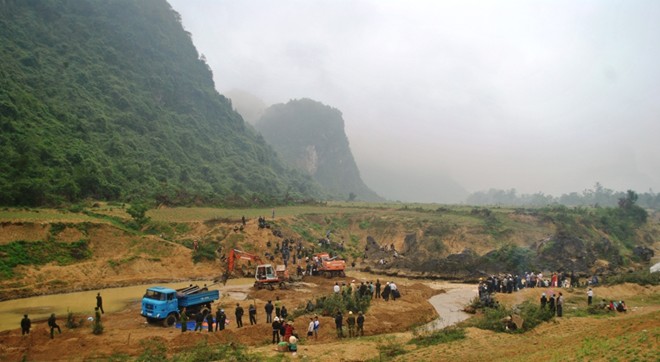
After two days, the valuable log was finally salvaged and transported by a specialized vehicle on February 26.The valuable log is 2.1m long, 1.1m in diameter and 2 tons in weight, worth about VND3 billion ($150,000).

Locals said that the log would have been in water for tens of years.
The log was transported to the Bo Trach Forest Protection Station for measurement and then was handed over to the Quang Binh authorities, said Mr. Tran Quang Vu, Vice Chair of Bo Trach District.
Vu said the log will be auctioned and 30 percent of the earnings will belong to the one who discovered the log.

The sua tree (Dalbergia tonkinensis Prain) has been listed as an endangered flora species in Vietnam and is on the international red list. Sua timber is rare and valuable, and as per local myth, can be used for spiritual purposes and treatment of some diseases in China. Therefore, the price for sua timber is very high.
sua timber, log,
 sua timber, log,
 sua timber, log,
 sua timber, log,
 sua timber, log,
 sua timber, log,
 sua timber, log,
 sua timber, log,
 sua timber, log,
 sua timber, log,
 sua timber, log,
 sua timber, log,
 sua timber, log,
 sua timber, log,
 sua timber, log,
 sua timber, log,
 sua timber, log,
 sua timber, log,
 sua timber, log,
 sua timber, log,

An Giang mother gives birth to conjoined twins


conjoined twins


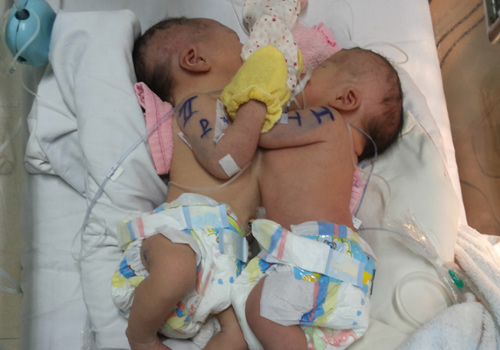
The family said that during the pregnancy, the woman had periodic antenatals. Doctors only discovered that she had the twins, not conjoined twins. On the day in labor, the woman was suddenly informed that her two sons were conjoined at the chest.Born on February 23, each baby weighed 2 kg. The twins were transferred to the HCM City Children's Hospital 1 for a separation surgery.Dr. Dao Trung Hieu, deputy director of the HCM City Children's Hospital 1, said the babies have conjoined sternums, with a large hole between it. Through this hole, part of the heart of the first baby enters the second child’s chest and vice versa.

Doctors also discovered that the two babies have congenital heart disease. Particularly, the first baby has narrowed blood vessels from the heart, only one kidney, no anus and the spine has abnormalities in the neck and tailbone. The second child has fluid in the kidney and ureter abnormalities.
"After making all the tests and diagnosis, we thought of surgery to separate the two bodies because the first baby does not have an anus. Without an operation, it may lead to fence congestion, causing infection," Dr. Hieu said.In related news, one baby in the conjoined twins who were separated at the HCM City Children's Hospital 2 last November died on February 23.

The baby - named Nguyen Hoang Phi Phung - was on life-support and died due to pneumonia and blood poisoning. His brother is still recovering from the surgery and will be released from the hospital soon The twins were born in Ninh Thuan conjoined between the thorax and the abdomen. They shared a heart, liver, biliary tract and had a defective abdominal wall and thorax.
The twins were born prematurely at a local medical clinic on Sept. 25, 2012. Doctors successfully separated the twins during a 10-hour procedure at Children Hospital 2 on Nov. 25, 2013.